Week 03 Classroom Notes: Game Feel and Videogame Aesthetics #
Core question: how do videogames create felt experience, aesthetic value, and cultural accountability?
Week 3 moves from rules and meaning into the feel of play. The focus is on the lived, bodily, perceptual and philosophical dimensions of games: how button presses become sensation, how systems become aesthetic experiences, and how this connects to the final essay question about what games should be accountable for as cultural forms.
Source Materials #
- Aesthetics of Videogames video
- Decoding Game Feel video
- From Button Presses to Infinite Games audio
- GMD102 Assessment Briefing PDF
- Week 12 Final Essay Template zipped Word document
- Week 12 Final Essay Template original Word document
1. Game Feel: Turning Input into Sensation #
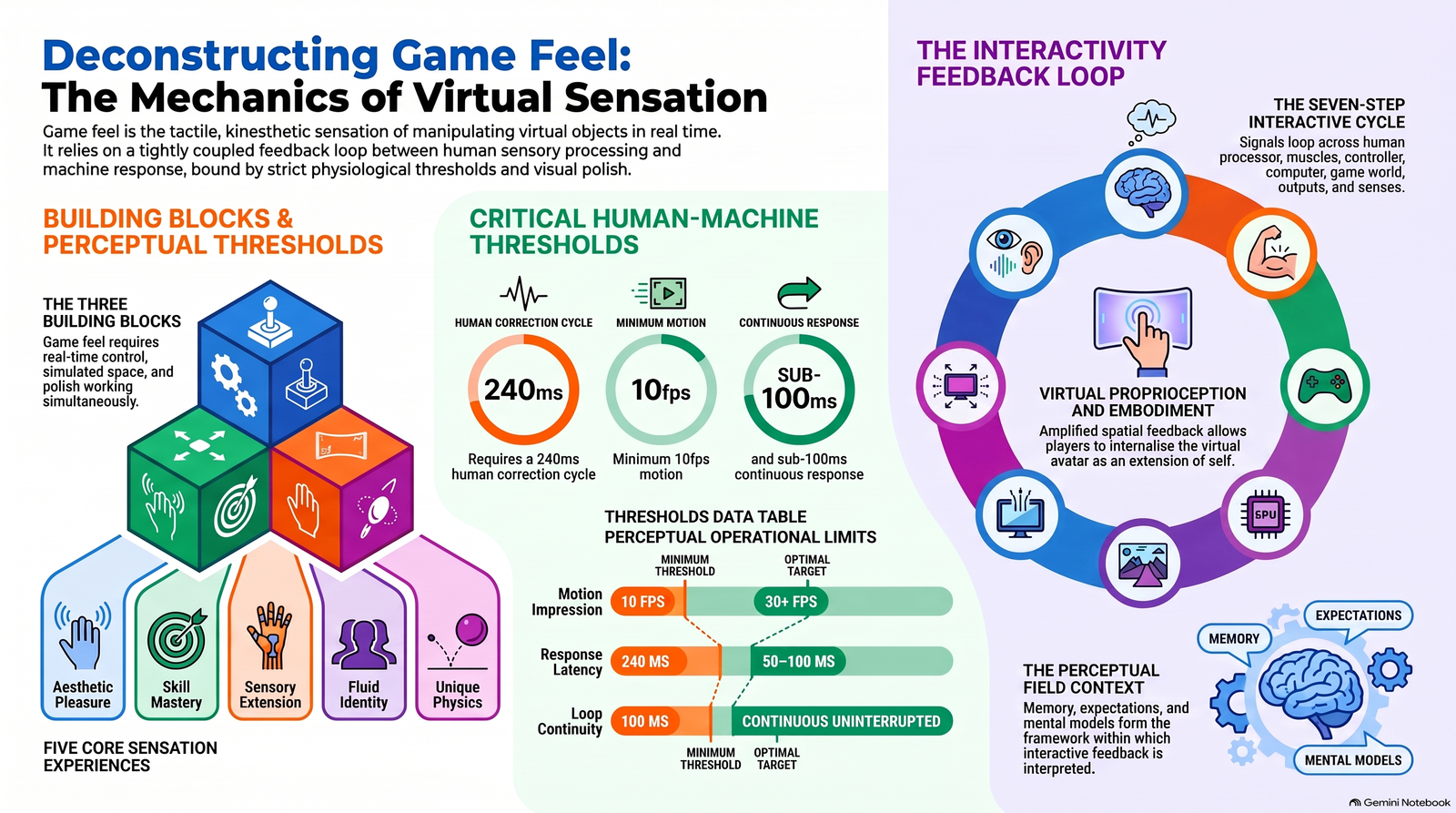
Game feel is the tactile and kinesthetic sensation of manipulating virtual objects in real time. It is produced by a tight feedback loop between player action, controller input, computational response, visual/audio output and bodily perception. When it works, the player stops thinking about individual button presses and begins to feel as if they are directly acting inside the game world.
- Real-time control: the player acts and sees the result quickly enough for correction, rhythm and intention to form.
- Simulated space: the game world gives actions spatial consequence through collision, gravity, acceleration, friction, camera movement and level geometry.
- Polish: animation, particles, sound, hit-stop, screen shake and other feedback effects make the system legible and satisfying.
The Week 3 infographic highlights useful thresholds: the human correction cycle is around 240ms, continuous motion becomes difficult below roughly 10 frames per second, and strong game feel usually depends on a continuous response loop under 100ms. The target is not only technical speed but perceptual confidence: the player needs to believe the system is responding to them.
2. Videogames as Aesthetic Objects #
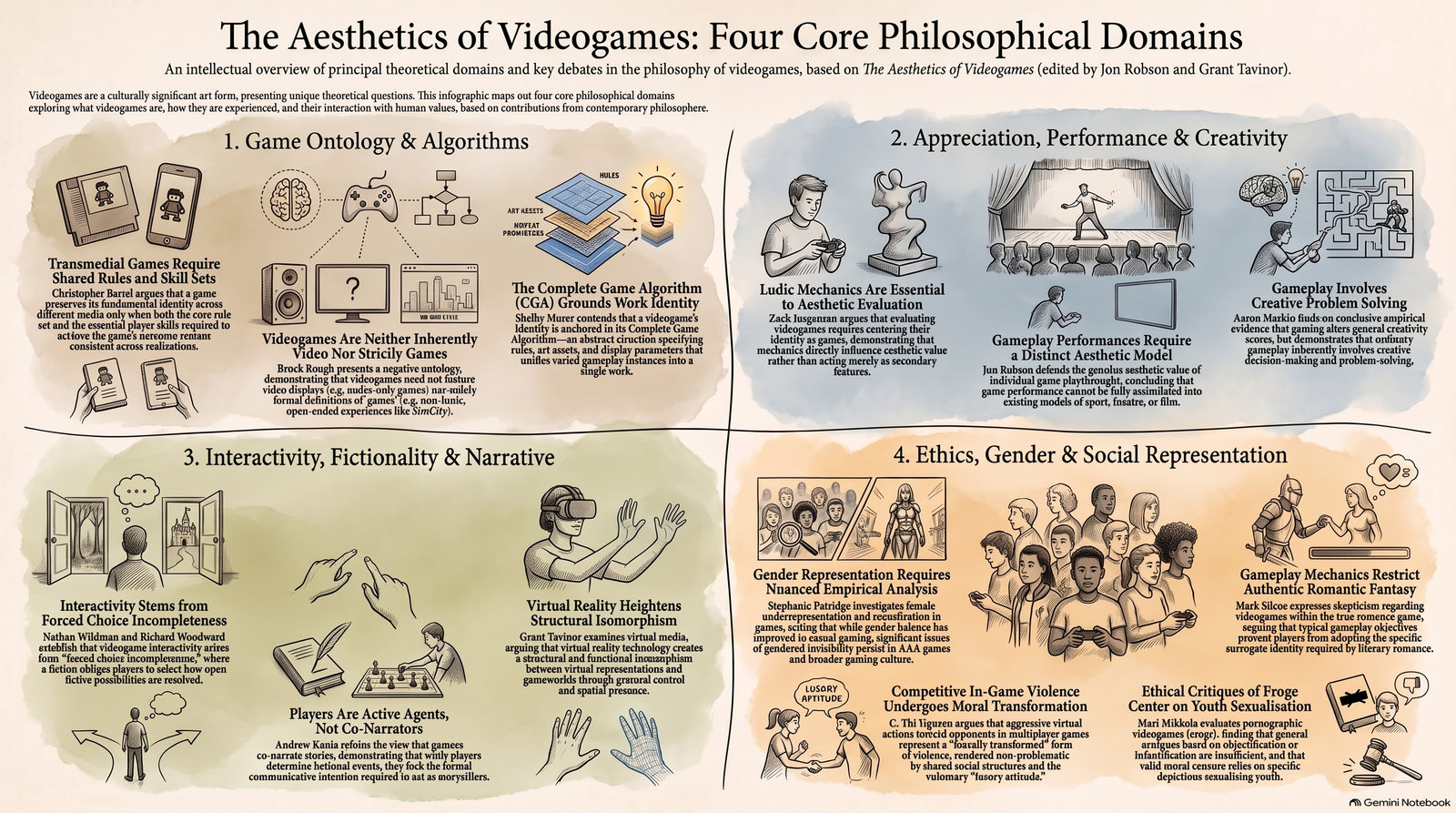
Videogame aesthetics are not limited to graphics or visual beauty. A game can be aesthetically interesting because of its rules, algorithms, interface, performances, failures, choices, social meanings and the way it asks players to inhabit a role. This means evaluation has to include what the player does, not just what the player sees.
- Ontology and algorithms: what kind of object is a videogame, and how do rules and algorithms define its identity?
- Appreciation, performance and creativity: how should we value skilled play, player improvisation, problem-solving and repeated attempts?
- Interactivity, fictionality and narrative: how do games position players as agents inside fictional and rule-bound structures?
- Ethics, gender and social representation: how do game systems transform, limit or intensify questions of violence, identity, agency and responsibility?
3. Infinite Play and Self-Authorship #
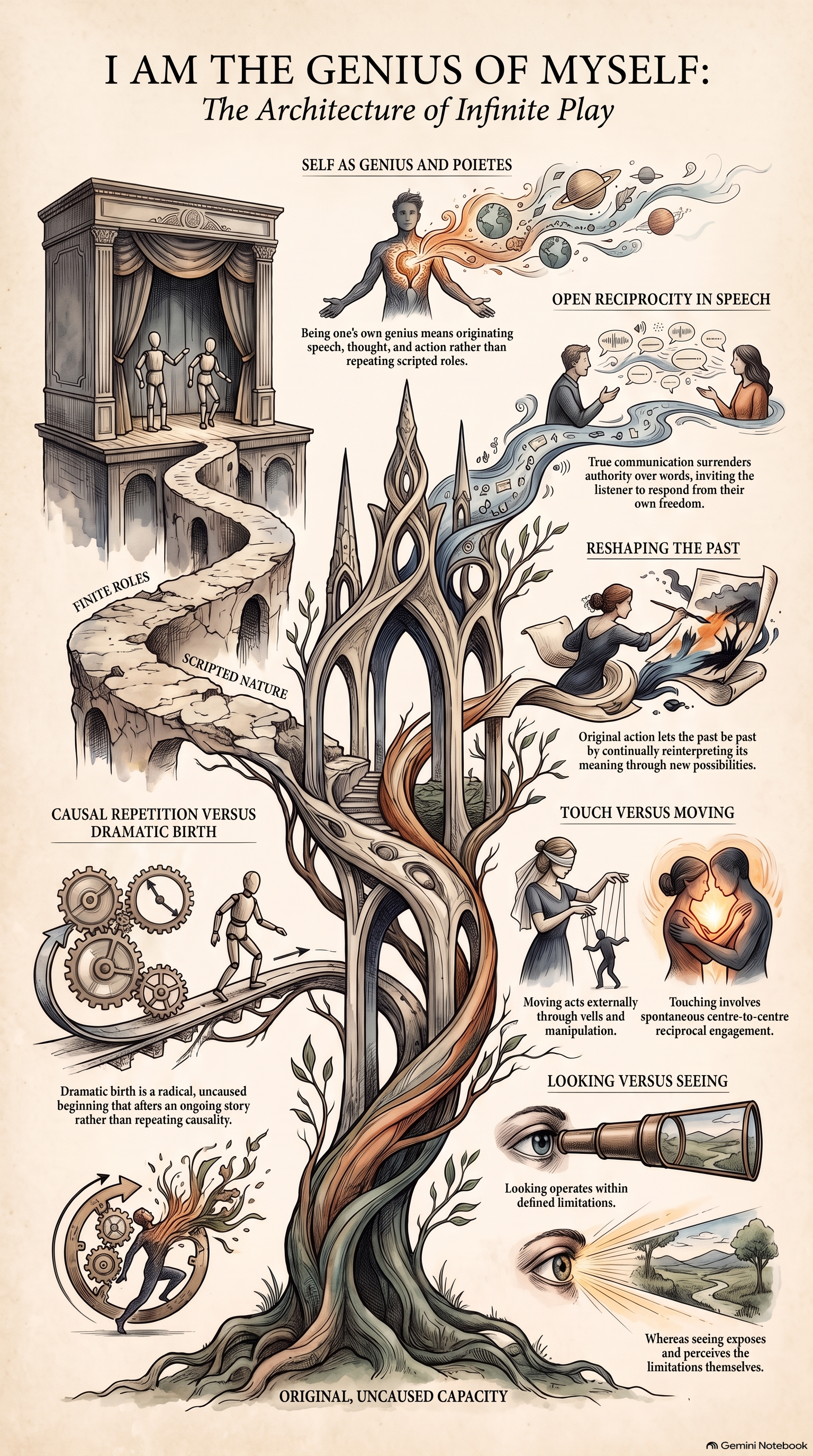
The infinite play material pushes the discussion beyond finite win/loss structures. It asks how games can create spaces for self-authorship, reciprocity, improvisation and ongoing transformation. This connects back to earlier work on rules, magic circles and meaningful play, but shifts attention toward what play can open rather than what it can settle.
- Finite play is organised around roles, boundaries, outcomes and closure.
- Infinite play values continuation, relation, becoming and the capacity to act otherwise.
- Self-authorship emerges when play allows players to remake their relation to a system, a role, a memory or another person.
4. Assessment Bridge: Accountability as the Essay Problem #
The assessment question is: What should games be accountable for as cultural forms? The final essay asks for a 2,000-2,500 word critical argument using one game as the main case study. The essay should connect close analysis of gameplay to theoretical frameworks and to legal, social, ethical, cultural or professional issues.
- Choose one game and build a sustained argument about how it shapes player experience.
- Use theory from the module to explain the game, not just describe it.
- Use gameplay evidence: rules, mechanics, interface, aesthetics, feedback, roles, representation, systems and player positioning.
- Draw on at least five strong academic sources and use Falmouth Harvard referencing.
- Include your online journal link and submit the essay as a Word or PDF document.
The Week 12 essay template gives a useful skeleton: introduction, journal link, main argument, theory and gameplay evidence, sections on player experience, identity, ethics, social systems, serious games, industry contexts and futures, followed by a conclusion and reference list.
Discussion Prompts #
- Where do you feel a game first: in the hands, the eyes, the ears, the rhythm of play or the decisions it asks you to make?
- Can a game have strong aesthetic value even if it looks visually simple?
- What makes game feel political or ethical, rather than merely technical?
- How might latency, polish, difficulty or feedback change a player’s sense of agency?
- What should your case-study game be held accountable for?
My Study Notes and Reflections #
Use this week to connect felt experience to argument. When you write your journal entry, choose one short moment of play and describe it closely: what the player does, how the system responds, what the moment feels like, and what larger cultural or ethical question that feeling might connect to.
Key Terms #
- Game feel
- Real-time control
- Simulated space
- Polish
- Feedback loop
- Virtual proprioception
- Embodiment
- Aesthetic evaluation
- Ontology
- Performance
- Interactivity
- Infinite play
- Cultural accountability
Archive and Source Files #
- Aesthetics_of_Videogames.mp4
- Decoding_Game_Feel.mp4
- From_button_presses_to_infinite_games.m4a
- Architecture_of_Infinite_Play.png
- Deconstructing_Virtual_Game_Feel.png
- Philosophy_of_Videogames_Overview.png
- GMD 102 Assessment Briefing (2).pdf
- Week 12 Final Essay Template zipped download
- Week 12 Final Essay Template (1).docx


