Week 04 Classroom Notes: Narrative and Interactivity #
Core question: how do games tell stories through choice, systems, space and player action?
Week 4 moves from game feel into interactive storytelling. The session asks how narrative operates when players are not only readers or viewers, but participants whose choices, movements and interpretations help produce meaning. The key tension is not simply whether games are stories or systems, but how story and system work together.
Source Materials #
- GMD102 Week 4 Narrative and Interactivity slide deck PDF
- Narrative and Interactivity video
- Narrative Architecture video
- How Game Mechanics Shape Interactive Stories audio
The book PDFs supplied for this week have been used as source readings and references rather than uploaded as public downloads. This keeps the site focused on teaching notes while avoiding redistribution of full copyrighted books.
1. Narratology and Ludology #
The classic debate asks whether games should primarily be understood as stories or as systems. Narratology treats games as narrative forms: worlds, characters, plots, dialogue, events and interpretation. Ludology treats games as rule systems: mechanics, goals, constraints, feedback loops and player action. Week 4 treats this as a productive tension rather than a binary choice.
- Narrative view: games communicate through story, character, setting and dramatic development.
- Systems view: games communicate through rules, procedures, mechanics and interaction.
- Combined view: interactive narrative happens when systems make story playable.
2. Ryan: Immersion and Interactivity #
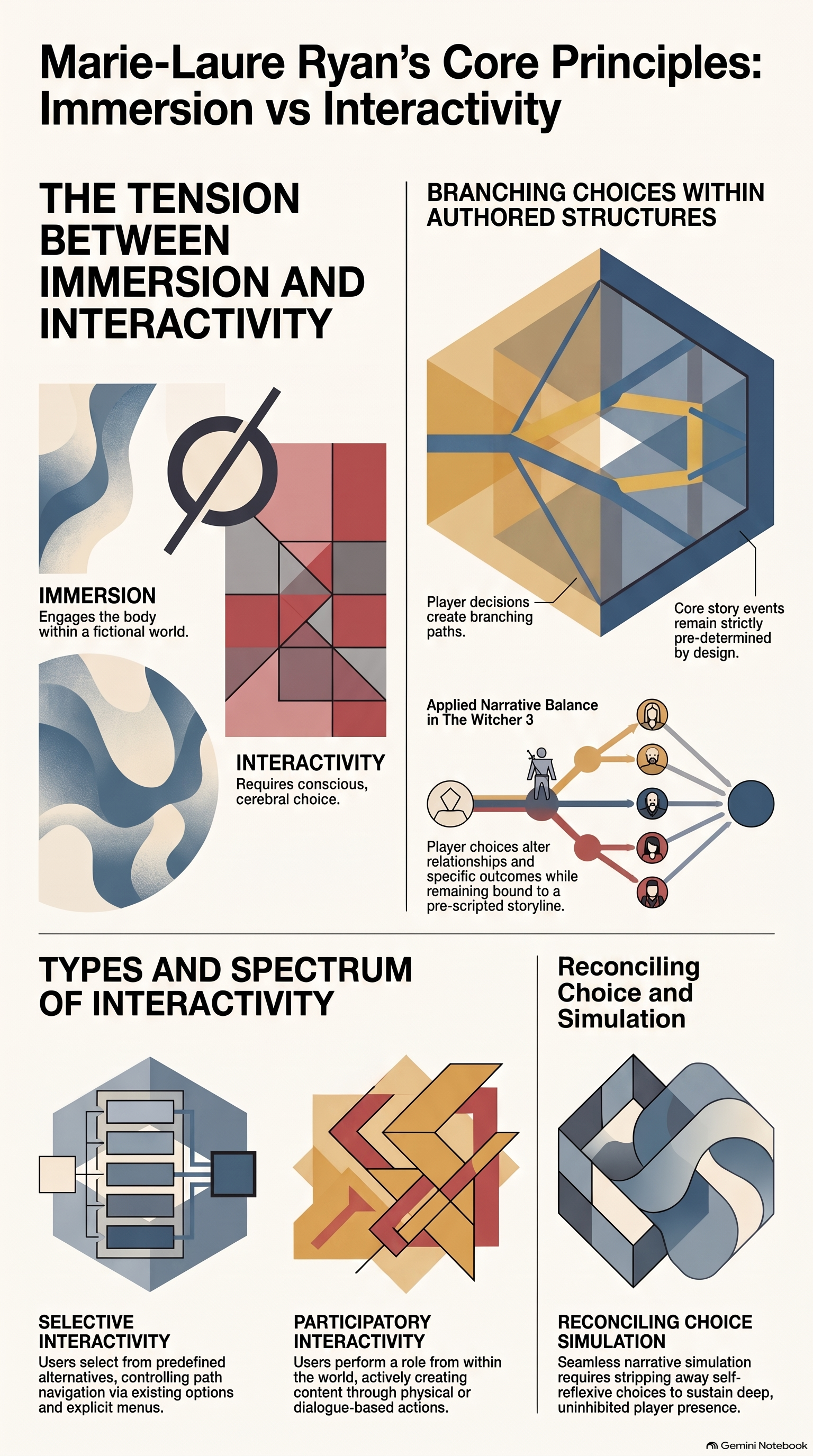
Marie-Laure Ryan helps frame the tension between immersion and interactivity. Immersion draws the player into a fictional world; interactivity asks the player to make choices, navigate alternatives and act within designed constraints. In games, the player may feel free, but that freedom is shaped by authored structures.
- Player choices can create branching paths.
- Key events may remain authored and structured.
- Freedom is meaningful because design gives it limits, consequences and context.
- The Witcher 3 is a useful example: choices alter relationships and outcomes while the wider story remains designed.
3. Jenkins: Narrative Architecture #
Henry Jenkins shifts attention from story as a script to story as a designed space. Narrative can be embedded in environments, objects, layout, routes and discoveries. Players do not only receive plot; they move through spaces that organise memory, atmosphere, history and possibility.
- Story can be communicated through environment and spatial design.
- Players discover meaning through exploration.
- Objects, architecture and layout can carry narrative information.
- Dark Souls is a strong example because lore is distributed across locations, enemies, items and environmental detail.
4. Murray: Agency, Immersion and Digital Affordances #
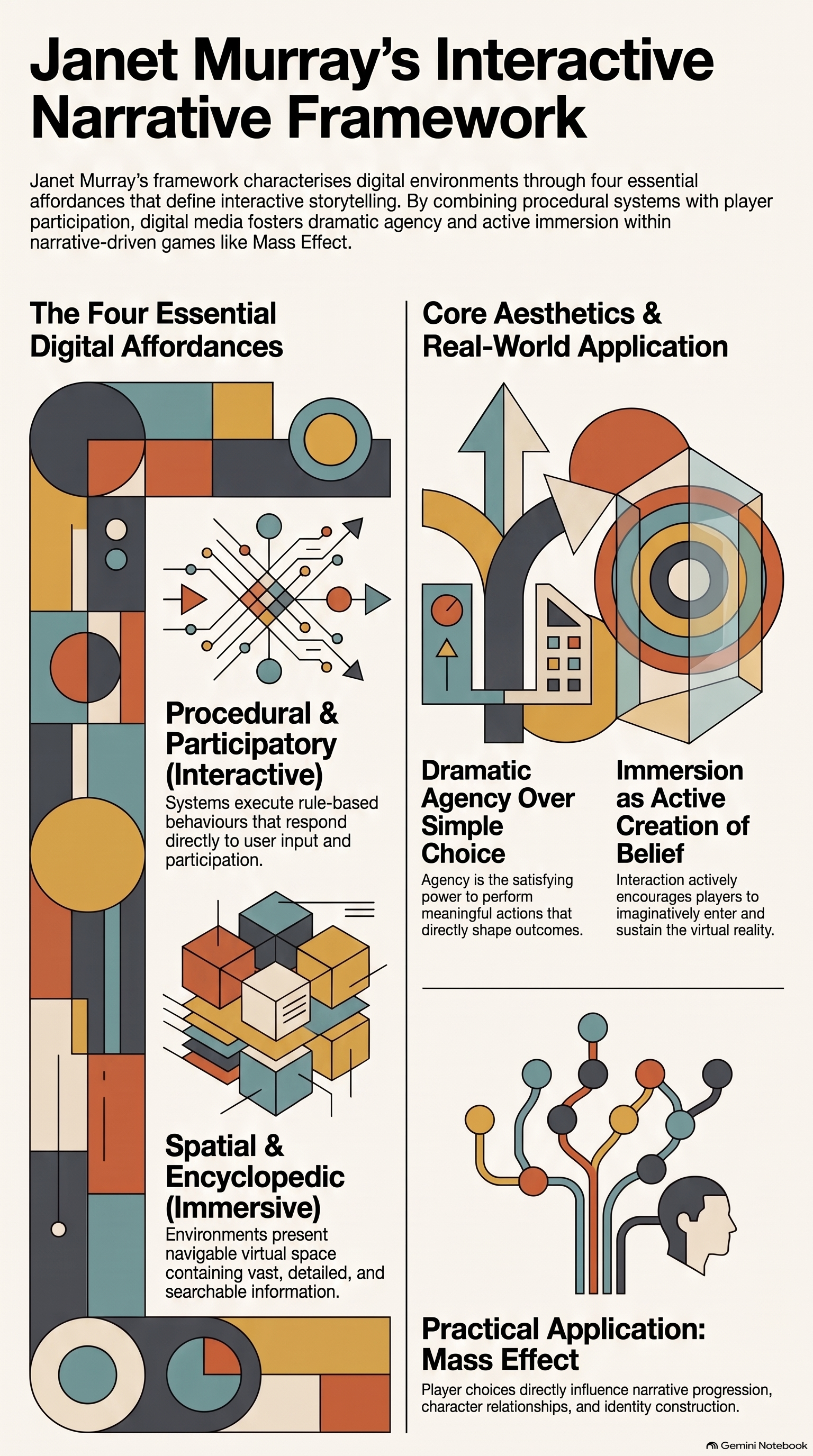
Janet Murray is useful for thinking about agency: the satisfying feeling that actions matter within a designed world. Agency is not the same as unlimited freedom. It is the sense that the game recognises the player, responds meaningfully, and lets participation shape experience.
- Procedural: digital environments execute rule-based behaviours.
- Participatory: they respond to input and invite action.
- Spatial: they present navigable worlds.
- Encyclopedic: they can contain extensive, searchable or explorable information.
5. Emergent Narrative and Player Identity #
Some narrative is scripted in advance; some emerges through play. Emergent narrative appears when mechanics, player decisions and system responses produce events that feel story-like without being fully authored line by line. This also shapes player identity: the player constructs a role through choices, failures, dialogue, movement, skill and interpretation.
- Scripted narrative: authored scenes, dialogue, quests and plot events.
- Emergent narrative: story-like meaning generated through systems and play.
- Player authorship: the player becomes a co-producer of meaning, but within designed limits.
6. Case Study: Disco Elysium #
Disco Elysium is useful because it resists the claim that games are simply interactive novels. It is dialogue-driven and literary, but its meaning comes from systems as much as prose: skills argue inside the protagonist, dice rolls shape outcomes, environments carry history, and choices construct identity.
- Narratology: dialogue, character, voice, worldbuilding and political themes.
- Ludology: skill checks, character build, inventory, movement, failure states and branching interactions.
- Critical point: the game is not just a story with clickable options; its systems make identity, uncertainty and interpretation playable.
Weekly PBL Activity #
Problem: a journalist claims Disco Elysium proves games are “just interactive novels.” Write a 250-word critical response in your journal that constructs a rebuttal using both narratology and ludology.
- Use one concrete example from play.
- Show how player interaction shapes narrative.
- Explain how systems produce meaning.
- Connect your response to Ryan, Jenkins or Murray.
Discussion Prompts #
- When does a game feel like a story?
- When does a game feel more like a system than a story?
- How do choices shape meaning if they are still constrained by design?
- How can an environment tell a story without dialogue?
- What kind of authorship does a player actually have?
My Study Notes and Reflections #
For your journal, choose one game moment where story and system meet. Describe what the player does, what the game system permits or blocks, how the world communicates meaning, and whether the player feels like a reader, performer, explorer, co-author or something else.
Key Terms #
- Narratology
- Ludology
- Interactive narrative
- Agency
- Immersion
- Interactivity
- Narrative architecture
- Emergent narrative
- Player authorship
- Environmental storytelling
- Procedural
- Participatory
- Spatial
- Encyclopedic
References and Reading Context #
- Jenkins, Henry. 2004. “Game Design as Narrative Architecture.”
- Murray, Janet H. 2016. Hamlet on the Holodeck: The Future of Narrative in Cyberspace. 2nd updated edition. MIT Press.
- Ryan, Marie-Laure. 2001. Narrative as Virtual Reality: Immersion and Interactivity in Literature and Electronic Media. Johns Hopkins University Press.
- Salen Tekinbas, Katie and Zimmerman, Eric, eds. 2006. The Game Design Reader: A Rules of Play Anthology. MIT Press.


