This is the main classroom-style note for Week 01 of GMD102. It gathers the lecture theme, source files, video, audio, infographics, definitions, examples, reflection prompts and references into one place.
Classroom Overview #
Week 01 asks a deceptively simple question: what is a game? The session introduces formal definitions from game studies, then opens them up to critique. The point is not only to memorise theorists, but to notice how every definition includes some forms of play and pushes others to the margins.
Core question: What counts as a game, and who gets to decide?
Before Class: Source Materials #
Use these as the raw materials for the week. The notes below bring them together into a classroom reading path.
Watch: The Rules of the Game #
Listen: Defining Games as a Political Act #
The Big Thread of the Session #
A traditional route into game studies begins with formal definitions: rules, boundaries, voluntary participation, challenge and outcomes. This is useful because it gives us shared vocabulary. But the critical route asks what those definitions hide: material conditions, politics, economics, access, identity and cultural context.
- First move: define games through rules, obstacles and play boundaries.
- Second move: compare different theorists and what each one notices.
- Third move: ask what gets excluded when definitions become too clean.
- Fourth move: apply the theories to examples like Wordle, golf, chess, gambling and make-believe.
1. Suits: Games as Unnecessary Obstacles #
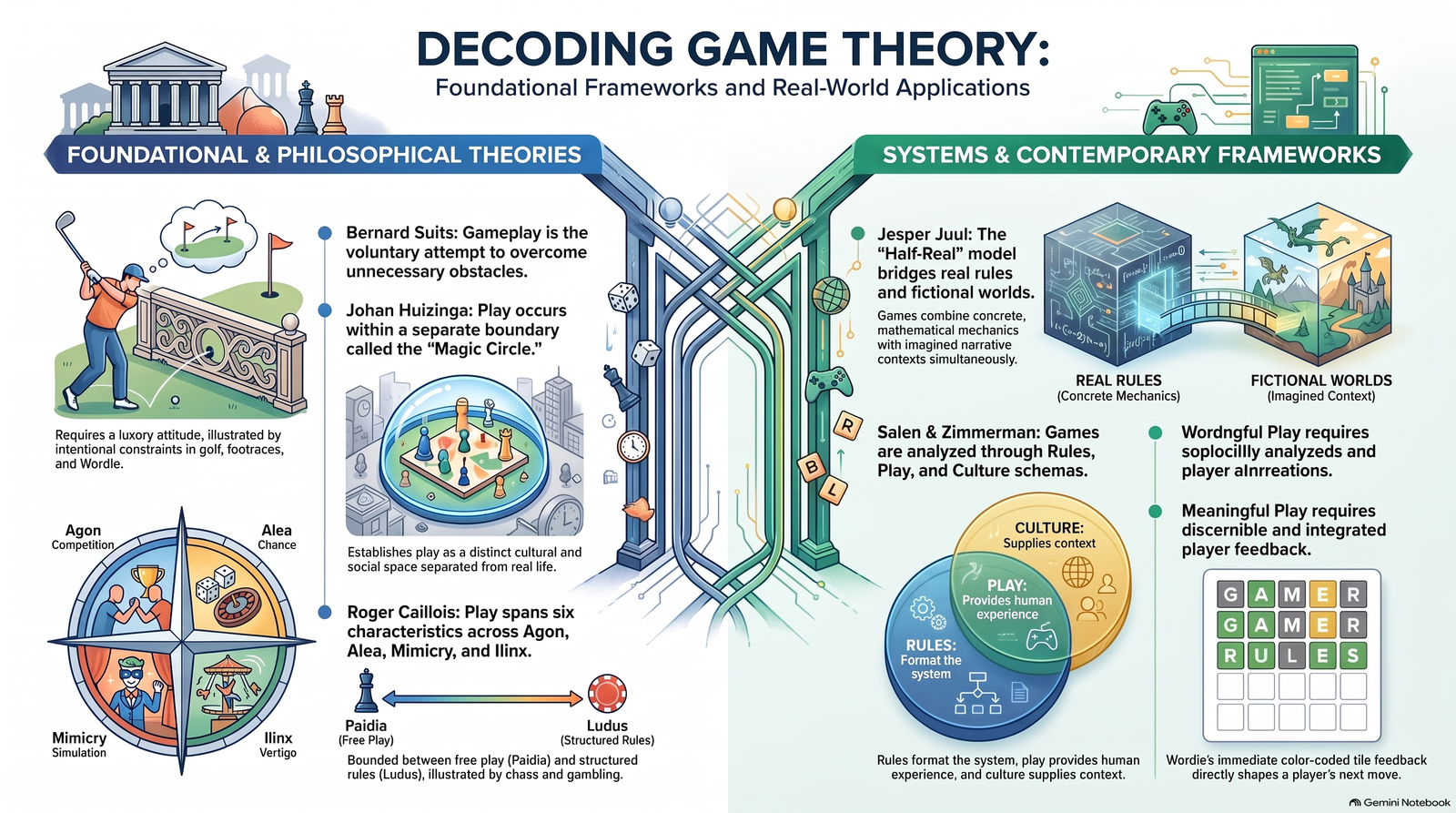
Bernard Suits gives one of the most memorable definitions: playing a game is the voluntary attempt to overcome unnecessary obstacles. A game is not just a goal. It is a goal pursued through deliberately inefficient means because the constraints are what make the activity playable.
The key term is the lusory attitude: the player accepts the rules because the rules create the game. In golf, the point is not simply to get the ball into the hole by the fastest possible method. The player accepts the club, the swing, the course and the restrictions. Without those accepted obstacles, the game disappears.
Classroom Example: Wordle #
Wordle is a clear Suits example. The efficient way to discover the answer would be to search for it or inspect the code. The game only exists because players accept unnecessary restrictions and agree to solve the puzzle within them.
2. Huizinga: The Magic Circle #
Johan Huizinga treats play as a free activity set apart from ordinary life. The magic circle is the idea that play happens within a temporary boundary where different rules and meanings apply.
This concept is useful because it explains why a chess piece, football pitch or digital game space can feel different from everyday life. But it can also be too neat. The political question is whether play is ever really separate from class, money, identity, labour, history or access.
3. Caillois: Categories of Play #
Roger Caillois extends and critiques Huizinga. He identifies play as free, separate, uncertain, unproductive, rule-governed and make-believe. He also gives a vocabulary for types of play: agon, alea, mimicry and ilinx.
- Agon: competition, such as chess, football or ranked play.
- Alea: chance, such as dice, lotteries or gambling.
- Mimicry: simulation, role-play, pretending or taking on another identity.
- Ilinx: vertigo, bodily disruption, thrill, speed or dizziness.
- Paidia: free play, improvisation and looseness.
- Ludus: structured play with explicit rules and goals.
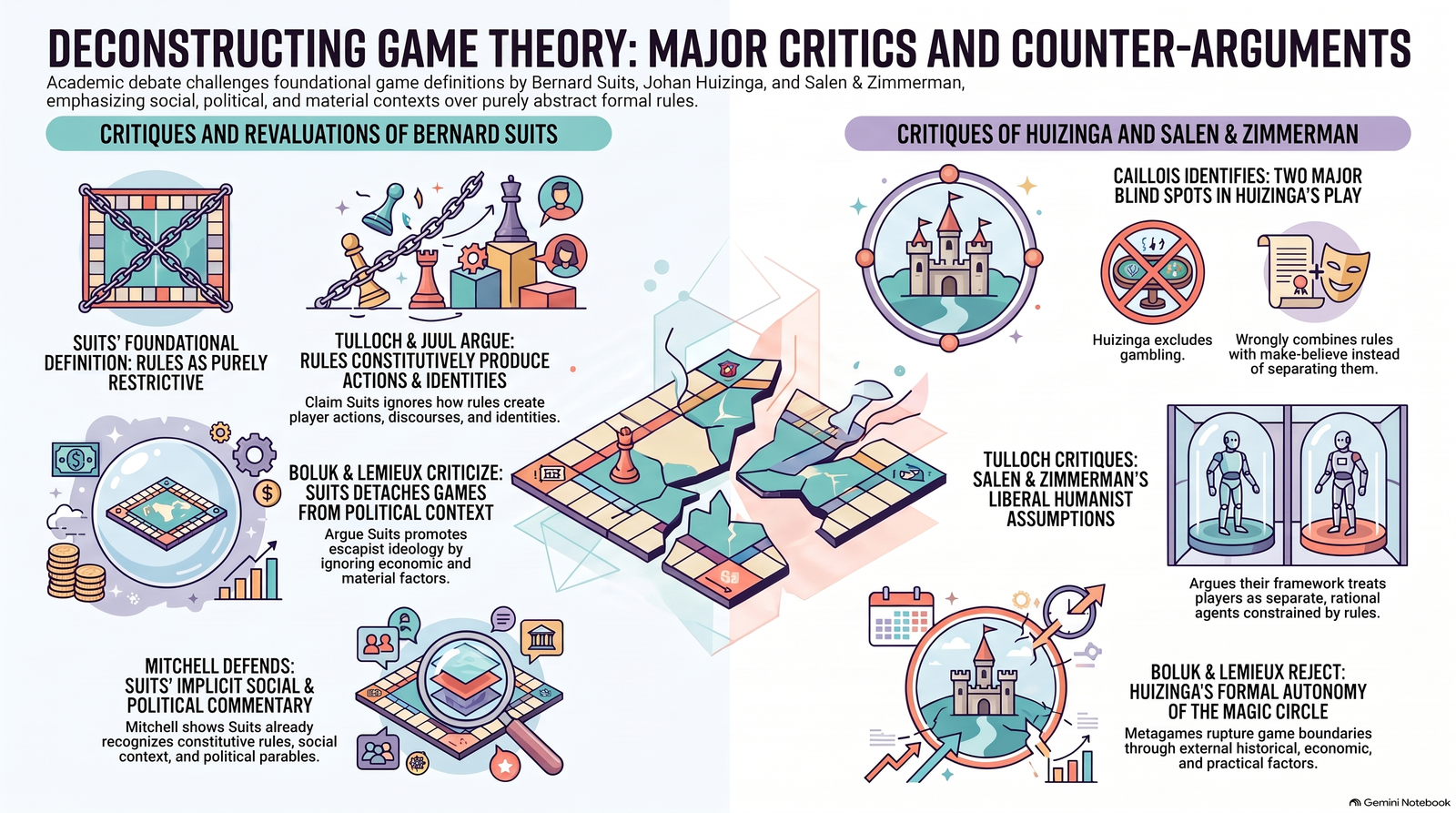
Caillois also challenges Huizinga for excluding gambling and for blending rules with make-believe. For Caillois, these are not always the same thing. A game can be rule-heavy without being make-believe, or imaginative without being strongly rule-bound.
4. Juul: Half-Real Games #
Jesper Juul argues that games are half-real: they combine real rules with fictional worlds. The rules are concrete and operational, while the fiction gives those rules context, meaning and atmosphere.
This is especially helpful for digital games. A damage number, collision system or win condition is real within the software. The dragon, city, kingdom or player identity may be fictional, but the player experiences the two together.
5. Salen and Zimmerman: Meaningful Play #
Salen and Zimmerman analyse games through rules, play and culture. Their key idea for this week is meaningful play: player action should produce feedback that is both discernible and integrated.
Wordle is again useful here. The coloured tiles are discernible because the player immediately understands that something has happened. They are integrated because the feedback directly shapes the next guess.
6. The Critical Turn: Definitions Are Political #
The more critical part of the week asks us to treat definitions as political acts. If a theorist defines games too narrowly, certain forms of play can be dismissed as not real games, not serious, not worthy of study, or not culturally legitimate.
Tulloch argues that rules do not only restrict players; rules also produce actions, identities and pleasures. Boluk and Lemieux push this further by arguing that formal definitions can detach games from their material, social and economic contexts. Their idea of metagaming challenges the fantasy that the game can be sealed away from the world around it.
Classroom Example: Golf #
A formalist reading of golf can focus on the elegant constraint: use a club to move a ball into a hole. A political reading asks what that abstraction leaves out: land use, class, access, exclusion, wealth and the social identity attached to the course. Both readings matter, but they do different work.
Visual Map of the Week #
In-Class Discussion Prompts #
- Is a puzzle always a game? What changes when the puzzle has rules, goals, feedback or social comparison?
- Does the magic circle protect play, or does it hide the real-world context around play?
- Can gambling be separated from play, or is Caillois right to bring it back into the discussion?
- When does a rule restrict the player, and when does a rule create the possibility of play?
- What would be lost if we defined games only through rules and outcomes?
- What would be lost if we ignored formal rules and focused only on politics and culture?
My Study Notes and Reflections #
Use this section after class or after reviewing the media. Keep it personal and practical: what clicked, what confused you, and what might help with coursework.
- What I understood:
- What I need to revisit:
- Useful examples for assignments:
- Questions to ask:
- Possible essay angle:
Key Terms #
- Lusory attitude: accepting game rules because they make the activity possible.
- Constitutive rules: rules that create the game rather than merely regulate it.
- Magic circle: the boundary that marks play as separate from ordinary life.
- Agon: competitive play.
- Alea: chance-based play.
- Mimicry: simulation, role-play or make-believe.
- Ilinx: vertigo, thrill or bodily disruption.
- Paidia: free, improvisational play.
- Ludus: structured play with rules and goals.
- Half-real: Juul’s idea that games combine real rules and fictional worlds.
- Meaningful play: action and feedback that are discernible and integrated.
- Metagaming: practices and contexts around games that challenge the idea of an isolated game object.
References #
- Boluk, S. and Lemieux, P. (2017). Metagaming: Playing, Competing, Spectating, Cheating, Trading, Making, and Breaking Videogames. Minneapolis: University of Minnesota Press.
- Caillois, R. (1961). Man, Play, and Games. Translated by M. Barash. New York: Free Press of Glencoe.
- Huizinga, J. (1950). Homo Ludens: A Study of the Play-Element in Culture. Boston: Beacon Press.
- Juul, J. (2005). Half-Real: Video Games between Real Rules and Fictional Worlds. Cambridge: MIT Press.
- Mitchell, L. (2020). Reconsidering The Grasshopper: On the Reception of Bernard Suits in Game Studies. Game Studies, 20(3).
- Salen, K. and Zimmerman, E. (2004). Rules of Play: Game Design Fundamentals. Cambridge: MIT Press.
- Suits, B. (2014). The Grasshopper: Games, Life and Utopia. Peterborough: Broadview Press.
- Tulloch, R. (2014). The Construction of Play: Rules, Restrictions, and the Repressive Hypothesis. Games and Culture, 9(5), pp. 335-350.
Archive and Source Pages #
These supporting pages keep the individual uploaded resources available separately, but this classroom note should be the main place to study Week 01.


