This is the main classroom-style note for Week 02 of GMD102. It gathers the week’s videos, audio, PDF, infographic, theory, examples and reflection prompts into one study page.
Classroom Overview #
Week 02 shifts from defining games to understanding how games produce experience. The central idea is that designers do not directly place feelings, meanings or behaviours into a player. They build systems of rules and feedback. Players encounter those systems, and meaning emerges through interaction.
Core question: How do mechanics become experience, and how can rules make an argument?
Before Class: Source Materials #
Use these as the raw materials for the week. The classroom notes below connect them into one reading path.
Watch: Unpacking the MDA #
Watch: Architecture of Play #
Listen: How Game Mechanics Shape Our Behaviour #
Listen: How Celeste Turns Failure into Resilience #
The Big Thread of the Session #
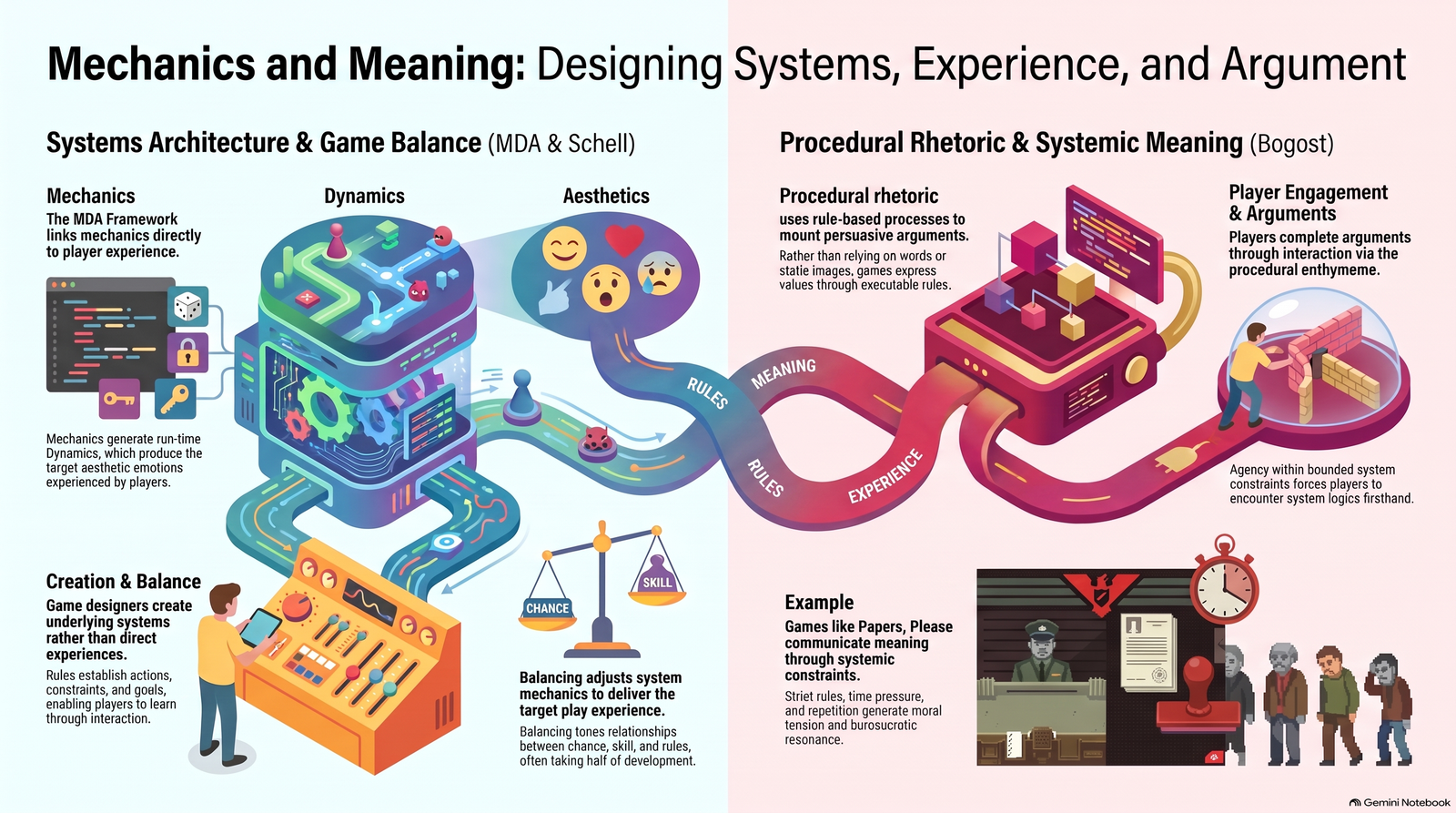
The week moves through three connected ideas. First, MDA explains how mechanics produce dynamics and aesthetics. Second, systems design reminds us that game designers create rules, constraints, goals and feedback loops rather than controlling player experience directly. Third, procedural rhetoric shows how a game can make an argument through processes rather than words alone.
- Mechanics: the rules, verbs, inputs, systems and constraints the designer creates.
- Dynamics: what happens when those rules run and players interact with them.
- Aesthetics: the felt experience that emerges for the player: challenge, tension, mastery, frustration, discovery, satisfaction or meaning.
- Procedural rhetoric: the idea that rule-based systems can persuade by making players perform and encounter an argument.
1. MDA: Mechanics, Dynamics, Aesthetics #
The MDA framework gives a useful way to move from design choices to player experience. Designers usually begin with mechanics, but players often remember the aesthetics: the feeling of mastery, fear, pressure, discovery or resilience.
The important classroom move is to avoid jumping straight from mechanic to emotion. The middle layer matters. A jump, dash, timer, restart button or resource counter only becomes meaningful through dynamics: repetition, pressure, strategy, failure, recovery and learning.
2. Systems Architecture and Game Balance #
Schell’s systems-design perspective helps frame the designer’s job. A designer builds an underlying system rather than a guaranteed experience. Balance is the process of tuning relationships between chance, skill, goals, constraints and feedback until the target experience becomes more likely.
This means a game can be understood as an architecture of play: a structure that channels possible actions and behaviours without fully determining what the player will feel or do.
3. Procedural Rhetoric: Rules as Argument #
Ian Bogost’s idea of procedural rhetoric is that games can argue through rules and procedures. A game does not only communicate through dialogue, images or story. It can persuade by making the player act within a system and feel the logic of that system firsthand.
The week’s infographic uses Papers, Please as an example. Its strict rules, time pressure and bureaucratic repetition create moral tension. The player does not just hear an argument about systems; they perform one.
4. Celeste: Failure, Repetition and Resilience #
Celeste is a strong case study because its mechanics are simple but demanding: jumping, climbing, dashing and instant restarts. These mechanics create a dynamic of rapid failure, repetition, adjustment and incremental mastery.
The PDF frames this through MDA and procedural rhetoric. Celeste’s difficulty does not only create challenge as an aesthetic category. Its friction-free restart loop makes failure part of the learning process. The system argues that persistence, patience and adaptation are necessary for overcoming obstacles.
Celeste Through MDA #
- Mechanics: precision movement, jump, climb, dash and instant screen restart.
- Dynamics: rapid trial, failure, repetition, pattern recognition and embodied learning.
- Aesthetics: challenge, tension, frustration, persistence, satisfaction and resilience.
- Procedural argument: repeated failure can become a structure for learning rather than a reason to stop.
Visual Map of the Week #
In-Class Discussion Prompts #
- Can a mechanic have meaning on its own, or does meaning emerge only through dynamics and context?
- How does a game designer shape experience without controlling it directly?
- What makes failure in Celeste feel productive rather than merely punishing?
- How does the MDA framework help analyse a game you already know?
- Can a game make an argument without dialogue or explicit narrative?
- What would happen if Celeste kept its difficulty but removed instant restarts?
My Study Notes and Reflections #
Use this section after class or after reviewing the media. Add your own examples, timestamp notes, and links to coursework ideas.
- What I understood:
- What I need to revisit:
- Useful examples for assignments:
- Questions to ask:
- Possible essay angle:
Key Terms #
- MDA: mechanics, dynamics and aesthetics as linked layers of game analysis.
- Mechanics: designed rules, verbs, inputs and constraints.
- Dynamics: run-time behaviours emerging from mechanics and player interaction.
- Aesthetics: the felt experience produced through play.
- Game balance: tuning system relationships to support a target experience.
- Procedural rhetoric: persuasion through rule-based processes.
- Procedural enthymeme: an argument completed by the player through interaction.
- Systemic meaning: meaning produced by rules, feedback loops and constraints.
- Resilience loop: the pattern of failure, restart, adaptation and mastery in Celeste.
References and Theory Anchors #
- Hunicke, R., LeBlanc, M. and Zubek, R. (2004). MDA: A Formal Approach to Game Design and Game Research.
- Schell, J. (2019). The Art of Game Design: A Book of Lenses. Boca Raton: CRC Press.
- Bogost, I. (2007). Persuasive Games: The Expressive Power of Videogames. Cambridge, MA: MIT Press.
- Extremely OK Games (2018). Celeste.
Archive and Source Files #
The files below are preserved as original source materials for this week.


